
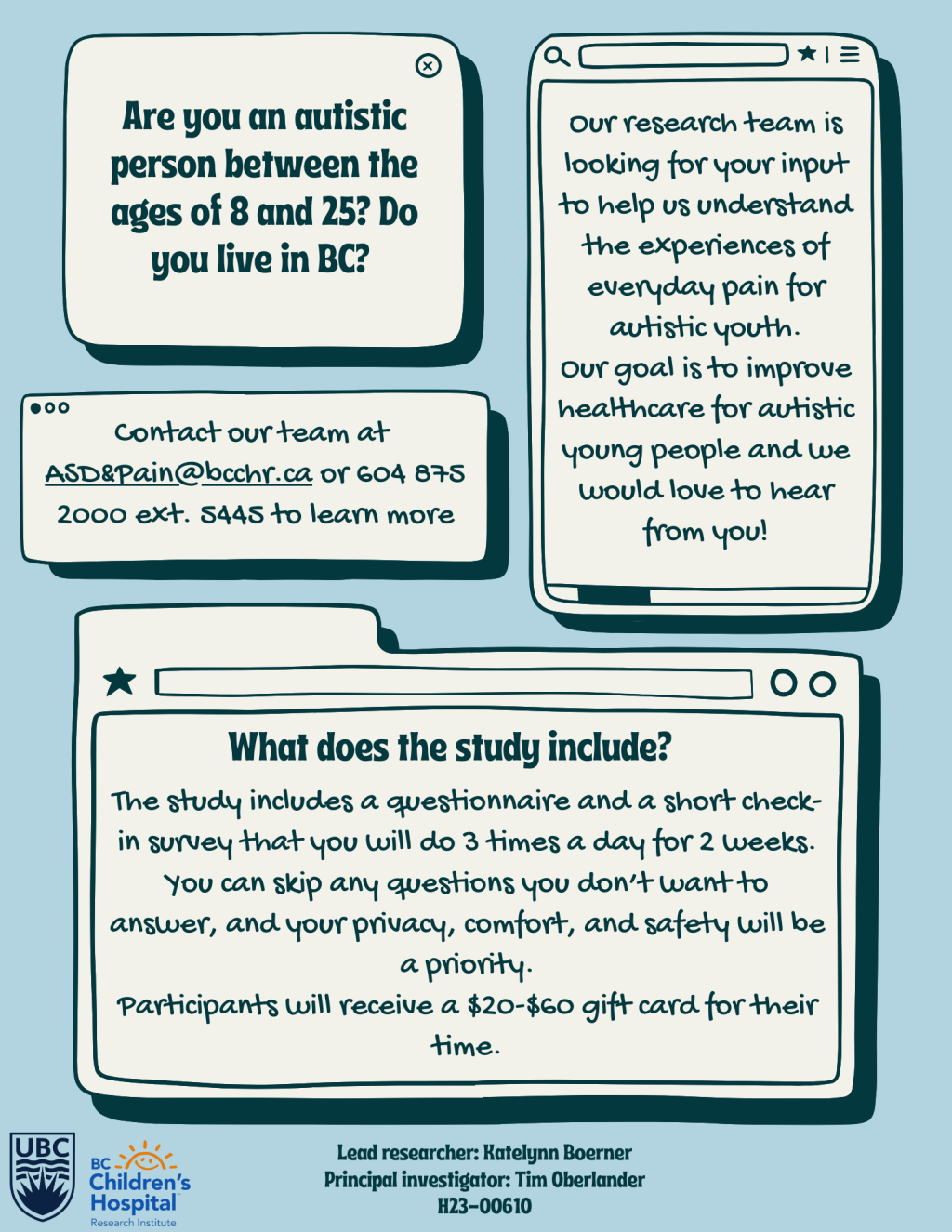
Researchers in British Columbia, Canada are hoping to learn more about experiences of pain in autistic young people. Here’s a message from the team:
Our research team at BC Children’s Hospital and the University of British Columbia is looking to understand the perspectives of autistic children and young people on pain. We are looking for youth who:
- Have a diagnosis of autism spectrum disorder
- Live in British Columbia
- Are between 8 and 25 years old
to participate in this study. The study contains an online questionnaire and an online check-in survey to be completed 3 times a week, for 2 weeks. Youth can skip any questions in the questionnaire and the survey that they don’t want to answer, and privacy will be protected throughout. In its entirety, participating in this study will take about 5 hours. Youth will receive a $20 gift card for completing the questionnaire, and an additional $20 gift card for each week at least 80% of the check-in questions are completed.
If you or someone you know might be interested in participating, please contact ASD&Pain@bcchr.ca or 604-875-2000 ext. 5445


One response to “Are You an Autistic Person Between the Ages of 8 and 25? Do You Live in British Columbia?”
Kristin,
It is great that they are studying pain in autistic individuals.
I evidently have a high tolerance for pain. I was not diagnosed until age 72 so I am late in understanding myself. I will relay my experience in case it is of value to anyone else.
Through my youth and adult life I had noticed that I rarely needed something like an aspirin. When I would have any type of medical intervention that might cause pain, like having my wisdom teeth removed, they would prescribe pain killers and I would get the RX filled since I believed the medical professional would know if pain was likely. But, I never needed the pain meds.
Then when I was about 60 I had to go to the emergency room. It was late afternoon and I called my doctor as I knew something was the matter; I was told to go to the ER as it was too late in the day for her to see me. I could tell something was wrong but I did not have pain. I knew I did not want to sit (bend my body) and that I wanted to stand or lay down. At the hospital I was offered pain meds but no, I did not feel pain, and said no thank you. I did say I wanted to lay down and not sit in the room; I said the same thing in the ambulance. The doctor ordered a urine sample to check for a UTI. He never examined me; I wondered why?????? Finally, after quite some time he ordered a CT scan and he returned to my room with the results. He was angry (his face, his words, his voice) and asked why I did not tell him I had a hernia? The surgeon had to remove 2 inches of my bowel as it had died, as well as repair the hernia. Likely I would not have lost 2 inches of bowel if the doctor had diagnosed the issue earlier before the bowel died.
Fortunately for me, the nurses at this particular hospital were known to be excellent. They taught me that I had an unusually high tolerance for pain. They evidently understood this due to my ER experience which they likely heard about and also my tolerance of the incision on my belly.
After being diagnosed on the spectrum, level one autism, I finally had an answer to the above as well as others autistic traits. I have since read that my pain tolerance is not unusual for autistics. I took to my current PCP a copy of the explanation in a book so she would be knowledgeable about this “idiosyncrasy” of mine and not necessarily expect pain as a symptom. I asked her if an incarcerated bowel would be painful and she said yes, very.
Thank you, Kristin, for your good work in behalf of the autistic community, Colette
I have noticed in other situations when a doctor makes a mistake, they start blaming the patient.
LikeLike